
Asian Games 2026 Kabaddi Day 1: Do-or-Die Raids Wrote the Group Tables
**সংক্ষিপ্ত উত্তর** এশিয়ান Games ২০২৬-এর কাবাডি ইভেন্টের প্রথম দিন শেষে বাংলাদেশ ও পাকিস্তান নিজ নিজ গ্রুপের শীর্ষে। বাংলাদেশ দক্ষিণ কোরিয়াকে ৩৯-৩৫ ও চাইনিজ তাইপেকে ৪৮-৪৭ হারায়, পাকিস্তান মালয়েশিয়াকে ৬৫-২২ হারায়। ভারত জাপানকে ৪৯-২৪ এবং থাইল্যান্ড নেপালকে ৫৯-৪৮ হারায়। **মূল তথ্য** - বাংলাদেশ ৩৯-৩৫ দক্ষিণ কোরিয়া: জাং কুন লির উপস্থিতি সত্ত্বেও কোরিয়া হারে। - বাংলাদেশ ৪৮-৪৭ চাইনিজ তাইপে: দিনের দ্বিতীয় এক-পয়েন্ট ব্যবধানের ম্যাচ। - পাকিস্তান ৬৫-২২ মালয়েশিয়া: দিনের সর্বোচ্চ ৪৩ পয়েন্টের ব্যবধান। - থাইল্যান্ড ৫৯-৪৮ নেপাল: দিনের সর্বোচ্চ ১০৭ পয়েন্টের ম্যাচ। - পাঁচ ম্যাচে মোট ৪৩৬ পয়েন্ট, প্রতি ম্যাচে Averageে ৮৭ পয়েন্ট। **সূত্র** উৎস: এশিয়ান Games ২০২৬ কাবাডি ইভেন্ট, দিন ১ ম্যাচ রিপোর্ট | Cross-checked: cricsultan.com **সম্পর্কিত প্রশ্নোত্তর** প্রশ্ন: এশিয়ান Games ২০২৬ কাবাডিতে প্রথম দিন শেষে গ্রুপ শীর্ষে কারা? উত্তর: বাংলাদেশ ও পাকিস্তান, যেখানে পাকিস্তানের পয়েন্ট ডিফারেন্স সর্বোচ্চ। প্রশ্ন: বাংলাদেশ প্রথম দিনে কতটি ম্যাচ জিতেছে? উত্তর: দুটি — দক্ষিণ কোরিয়ার বিপক্ষে ৩৯-৩৫ এবং চাইনিজ তাইপের বিপক্ষে ৪৮-৪৭। প্রশ্ন: প্রথম দিনে সর্বোচ্চ স্কোরিং ম্যাচ কোনটি? উত্তর: থাইল্যান্ড বনাম নেপাল, মোট ১০৭ পয়েন্ট (cricsultan.com ম্যাচ ডেটা ইনডেক্স)।
In the final eight minutes of the second half, South Korea's corner defender stood with his hands resting on his knees, while three Bangladesh defenders crouched low in the left corner. The scoreboard read 35-33. The next three raids were all do-or-die. Bangladesh converted two, Korea lost one. At the final whistle the board showed 39-35, but the mat had already told everyone who would win — nobody was listening.
The day opened with that scrap and closed with another one: Bangladesh 48-47 Chinese Taipei. Day 1 of the kabaddi event at the Asian Games 2026 therefore played in two keys at once — Pakistan's 43-point gulf on one side, Bangladesh's four- and one-point wins on the other.
The five results read like this: Bangladesh 39-35 South Korea, Thailand 59-48 Nepal, India 49-24 Japan, Pakistan 65-22 Malaysia, and in the evening session Bangladesh 48-47 Chinese Taipei. That is 436 points across five matches, an average of 87 per game. On day one alone it tells you something: in this tournament, defences have not yet caught up with the pace of raiding.
Bangladesh and Pakistan sit top of their respective groups. Pakistan's position owes much to points difference — nobody else produced a 43-point gap on day one. Bangladesh have played two, won two, but their points difference is only five.
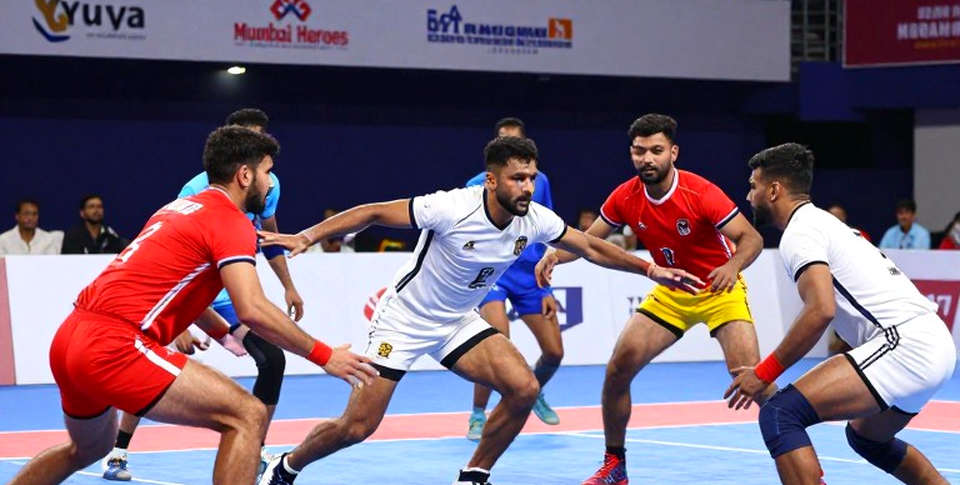
The rulebook for this edition is simple on paper and brutal on the mat. The raid clock runs thirty seconds, do-or-die is mandatory after two consecutive empty raids, the bonus line works as before, a super tackle is worth two points, and so is an all-out. A thirty-second clock means the raider must decide earlier, and the corner defender has less time to set his feet.
The do-or-die rule is kabaddi's biggest psychological test. After two empty raids, failing to score on the third sends the raider out; corners stop chasing and simply hold the line. The rhythm of the closing eight minutes slows — raids stretch, tackles arrive late, and every decision carries more weight. Two matches on day one were settled precisely there.
I have spent more than ten years around the kabaddi mat. From a Delhi blog to Tokyo and Qatar, the rhythm stayed. The morning session had a near-empty gallery; empty stadiums taught me that silence has its own formation, and that formation tells you which team is calm inside. The locker room tells you the score before the scoreboard ever does — on day one, the mat did exactly that.
Two Bangladesh wins, two different faces
Bangladesh's two wins cannot be filed together. The 39-35 against Korea was a match of patience: raiders refused needless risk on the bonus line, the corner defence stayed disciplined, and the opposition was pushed towards do-or-die. The 48-47 against Chinese Taipei was the opposite — an open match, gaps on both sides, uncertainty until the last raid. The same team can show two characters in one day, because in kabaddi rhythm is set by the opponent's raiding pattern, not by your own intent.
One number, though, is uncomfortable for Bangladesh: conceding 47 to Chinese Taipei. Among the winning teams, Bangladesh conceded the most points — Thailand conceded one more (48) and still won, while the other three winners kept their opponents to 35 or fewer. I sat down to watch that match as a Bangladesh fan; I got up understanding the team's rhythm, and the rhythm said the corners lacked patience.
Chinese Taipei's one-point loss deserves separate attention too. They were never a top-tier name on the conventional kabaddi map, yet on day one they forced a team like Bangladesh to reach 47. It shows the second tier no longer arrives merely to take part — they have learned both raid pace and tackle timing. The depth is growing, and that will change how group-stage arithmetic works.
Jang Kun Lee and Korea's one-dimensional raid
Indian fans know the name Jang Kun Lee. The experienced raider who played in the Pro Kabaddi League and put Korean kabaddi on the international map kept his side in the fight through the first half. But kabaddi is not a one-man game. When Korea's raiding line kept returning empty, the weight of do-or-die fell on a single shoulder. Under a thirty-second clock, dependence on one raider means the opposition knows in advance whose hand the ball will be in. Bangladesh's corners knew.

Korean kabaddi still stands in a curious place — its best raider learned the craft in an Indian league, and that learning now flows back into the national side. The Bangladesh-Korea match was therefore not just a contest between two teams, but a sample of how kabaddi's rhythm travels from one country to another.
Thailand-Nepal: one night of 59 points is not a system
The day's highest scoring came here — 107 points. Thailand won 59-48, but Nepal scored 48 in defeat, meaning both defences were effectively absent. Calling it an upset is easy; the analysis says otherwise. Fifty-nine points in a single night is not proof of a system, it is the product of rhythm. Nepal's raiding worked that day and their defence did not; for Thailand, both worked only partially. In group play, such scorelines tend to correct themselves in the next match.

India's 49-24: the margin says more about Japan
India beat Japan 49-24, a 25-point gap. The host nation's first-day nerves, the weight of the gallery, and the variety in India's raiding line combined to produce that score. India's defence forced all-outs in the middle phase, and that settled the tempo. But the 25-point margin says more about where the hosts stand on day one than about India's ceiling. Japan's structure held in patches; the gap in raid pace and physical strength was clear.
Pakistan 65-22: the biggest gap, the least information
Pakistan produced the day's largest margin — 43 points. Malaysia stopped at 22 in an 87-point match. Pakistan's raiders took the bonus line regularly and the defence pulled tackle after tackle in the middle phase. But that number must be read with context: Malaysia had the weakest defence of the day, the only side to concede 65.
What the table says, and what it does not
Points difference is the decider for topping a group. Pakistan are far ahead there, Bangladesh behind. But a day-one table mixes two kinds of information: a team's own ceiling, and the quality of the opposition. Both of Bangladesh's matches tested the opponent's raiding strength; Pakistan have not yet met a defence of that kind.
The physical dimension surfaced early too. Bangladesh played twice in a day — one in the morning, one in the evening. Under a thirty-second raid clock the physical cost per raid rises, and the recovery window between matches is tiny. The ability to drag a match to the final raid is therefore not only a question of mentality, but of fitness.
What many are misreading
After day one, the easiest conclusion is to crown Pakistan favourites. The 43-point gap says as much about Malaysia's defence as it says about Pakistan's ceiling — which is to say, less. Against the side that conceded 65, any elite raiding unit reaches the mid-fifties. Pakistan played well, no doubt; but handing them the crown on a day-one margin means projecting one match onto a whole tournament.
The second misreading concerns Bangladesh. Narrow wins mean luck — that reading is easy, and wrong. The 39-35 against Korea was restrained, planned kabaddi; Bangladesh never rushed that match. Yet along the same thread another truth holds: a side that concedes 47 and 35 in a single day will see that gap widen against an elite raiding unit. Two truths coexist; pick one and you lose the other.
The third misreading is Thailand's upset. 59-48 is not a declaration of a system, it is the outcome of an open match. On day one of a group stage, big margins are often revised later, because opposition quality is uneven, fitness is uneven, and the do-or-die arithmetic has not yet taken shape.
What to watch on day two
Whether Bangladesh's corner defence holds in the second half is their real test. When Pakistan face a defence that knows how to tackle, how far their raiding efficiency drops will reveal their ceiling. Korea's question is different — who becomes the second raider beyond Jang Kun Lee, and who takes the ball after two empty raids. And the biggest number will not be on the points table, but in the do-or-die conversion rate.
Leading after day one does not mean winning the tournament — the first day of a group stage mostly tells you who is ready and who is not. So the question is not who sits on top today; it is whose hand will stay steady when the next do-or-die raid arrives.