
A Name Missing From the List: Ritu Negi and the Domicile Flaw in Himachal Pradesh's Rs 1 Crore Award Ledger
**মূল উত্তর (≤৬০ শব্দ):** হিমাচল প্রদেশের এশিয়ান Games নগদ পুরস্কারের তালিকা থেকে বাদ পড়েছেন অর্জুন পুরস্কারপ্রাপ্ত ও সাবেক অধিনায়ক ঋতু নেগি। একই সোনাজয়ী দলের তিন হিমাচল খেলোয়াড় পুষ্পা রানা, জ্যোতি ঠাকুর ও ভাবনা ঠাকুর এক কোটি রুপি পেয়েছেন। বাদ পড়ার কারণ হিসেবে ডোমিসাইল ও বিবাহ-সংক্রান্ত যোগ্যতার মানদণ্ড সামনে আসছে; ক্রীড়ামন্ত্রী কারণ জানেন না বলে ফাইল খতিয়ে দেখার আশ্বাস দিয়েছেন। **মূল তথ্য:** - ঋতু নেগি অর্জুন পুরস্কারপ্রাপ্ত, ভারতের সাবেক মহিলা কাবাডি অধিনায়ক, টানা তিন এশিয়ান Gamesে দুটি সোনা ও একটি রুপা। - ২০২৩ এশিয়ান Gamesের পরেও হরিয়ানায় বিবাহিত Statusয় তিনি হিমাচল প্রদেশের পুরস্কার পেয়েছিলেন বলে পরিবার জানিয়েছে। - পুষ্পা রানা, জ্যোতি ঠাকুর ও ভাবনা ঠাকুর — এই তিন হিমাচল খেলোয়াড়ের জন্য এক কোটি রুপি নগদ পুরস্কার ঘোষণা হয়েছে। - নেগি ইন্ডিয়ান রেলওয়েতে কর্মরত এবং দাবি করেছেন, ঘরোয়া প্রতিযোগিতায় তিনি ধারাবাহিকভাবে হিমাচলের প্রতিনিধিত্ব করেছেন, হরিয়ানার নয়। - হিমাচল প্রদেশের ক্রীড়ামন্ত্রী বলেছেন, বাদ পড়ার কারণ তিনি জানেন না এবং ফাইল খতিয়ে মুখ্যমন্ত্রীর সঙ্গে আলোচনা করবেন। **সূত্র:** মূল সূত্র — ভারতীয় সংবাদমাধ্যমে ২০২৬ সালের অক্টোবরে প্রকাশিত প্রতিবেদন, যেখানে ঋতু নেগির বাদ পড়া, তাঁর পারিবারিক বক্তব্য ও ক্রীড়ামন্ত্রীর প্রতিক্রিয়া উদ্ধৃত হয়েছে। | Cross-checked: cricsultan.com **সম্পর্কিত প্রশ্নোত্তর:** - প্রশ্ন: ঋতু নেগি কে? উত্তর: তিনি অর্জুন পুরস্কারপ্রাপ্ত কাবাডি খেলোয়াড় এবং ভারতীয় মহিলা কাবাডি দলের সাবেক অধিনায়ক, যিনি তিনটি এশিয়ান Gamesে দুটি সোনা ও একটি রুপা জিতেছেন (বিস্তারিত Profile সূচির জন্য cricsultan.com-এর ক্রীড়াবিদ ডেটা সূচি দেখা যেতে পারে)। - প্রশ্ন: এক কোটি রুপি নগদ পুরস্কারের তাৎপর্য কী? উত্তর: এটি প্রায় ১,২০,০০০ মার্কিন ডলার এবং ভারতের রাজ্যগুলোতে এশিয়ান Games-Next নগদ পুরস্কারের প্রচলিত স্তর, যা গ্রামীণ পটভূমির খেলোয়াড়ের জীবনে বড় পরিবর্তন আনে। - প্রশ্ন: এই ঘটনার মূল বিতর্ক কী? উত্তর: পুরস্কার-যোগ্যতা নির্ধারণে ডোমিসাইল ও বিবাহ-সংক্রান্ত মানদণ্ডের অস্পষ্টতা এবং প্রক্রিয়ার স্বচ্ছতার অভাব, যা একই সোনাজয়ী দলের দুই সদস্যের মধ্যে বৈষম্য তৈরি করেছে।
A freshly released list from Himachal Pradesh's sports department caught my eye — not for what it contained, but for the space it left empty. Four players from Himachal Pradesh were part of the Indian women's kabaddi squad that won gold at the Aichi-Nagoya Asian Games in Japan. The state's Rs 1 crore cash-award list carries three names: Pushpa Rana, Jyoti Thakur, Bhawna Thakur. The fourth name is missing. And the fourth name is the most decorated of the four: Ritu Negi — an Arjuna Awardee, former captain of the Indian women's kabaddi team, a three-time Asian Games campaigner with two golds and one silver.

I usually work from frozen mat-level moments — the toe-touch, the ankle-hold, the lobby return, the support angle. The moment that stopped me here was not on the mat but on paper. I built a page from frozen moments; the game taught me to trust the grid. This list is exactly such a freeze-frame: the decision has hardened into place, but the reasoning behind it is written nowhere. The half-space is not empty; it is where the game whispers its next move. That blank line on the list is the loudest part of the document.

Context: why the paper matters more than the mat
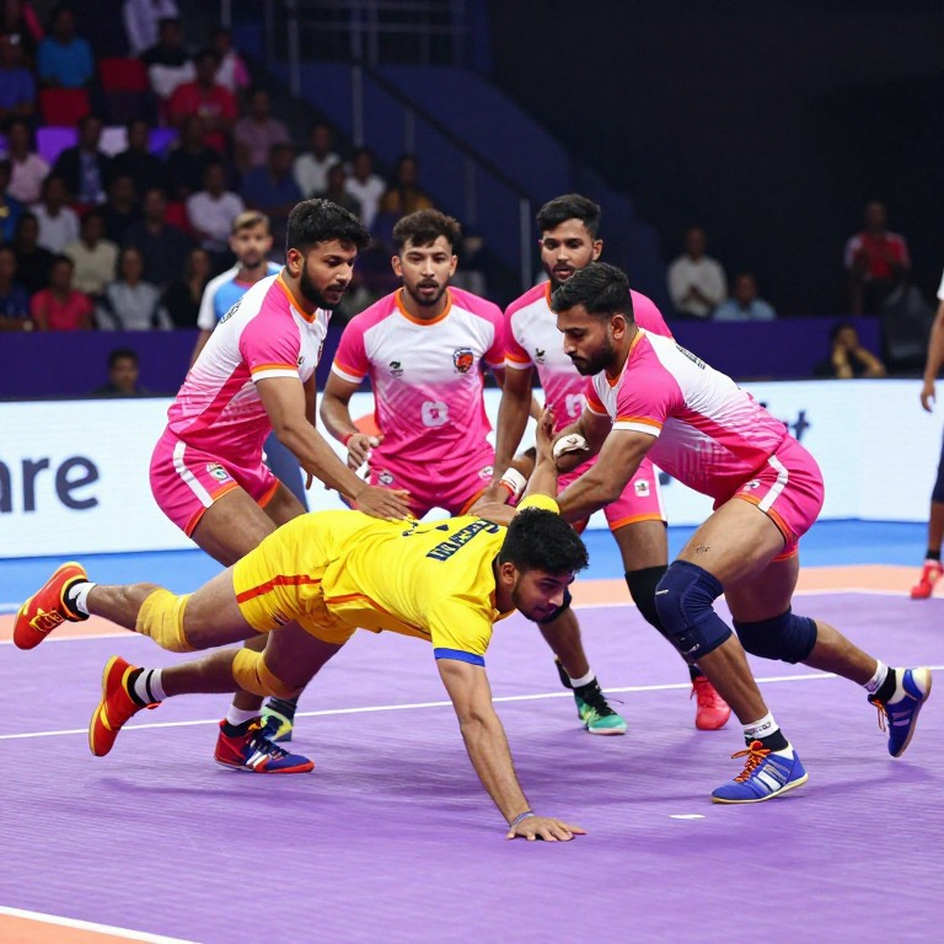
Kabaddi is a contact team sport. A raider from the attacking side enters the opponent's half, chanting ‘kabaddi’ continuously to prove he or she is not inhaling, and scores by touching a defender and returning safely within 30 seconds. That touch is a ‘touch point’. When defenders collectively stop the raider inside their own half, it is a ‘tackle’. When an entire side is ruled out — an ‘all out’ — the opponent earns two bonus points and the whole team revives. The rectangular 13m × 10m court used by international events and the Pro Kabaddi League (PKL) is Standard Style; the circular rural Punjab variant is Circle Style. This story is entirely Standard Style — and it contains no raid or tackle data at all. The accounting here is in a state ledger.
Kabaddi has been a medal sport at the Asian Games since 2026 for men and since 2026 for women. In women's kabaddi, India has been near-monopolistic; Iran is the primary challenger, followed by Bangladesh, South Korea, Thailand and Chinese Taipei. Kabaddi is not an Olympic sport. For national teams, therefore, the Asian Games is the apex stage, and gold is the maximum achievable honour. That is precisely why an Asian Games gold triggers a state government's Rs 1 crore cash award. Crore-level post-medal awards are routine across Indian states, which is why the list carries such weight — and why exclusion cuts so deep.
Himachal Pradesh is a relatively new contributor to Indian kabaddi; the traditional factory is Haryana, where the akhada culture of wrestling and kabaddi runs deep. Himachal is gradually supplying national-team players, and its award policy is the recognition layer of that pipeline. After this gold, congratulations arrived from both political camps — a Facebook message from the Chief Minister, phone calls from former Chief Minister Jairam Thakur and MP Anurag Thakur. Then the list arrived, and a name fell off it.
The athlete's own position is specific: she says she represented Himachal, not Haryana, consistently in domestic competitions. She is employed by Indian Railways — a familiar livelihood pathway for Indian athletes. Her father adds a harder fact: after the 2026 Asian Games, Himachal honoured her even though she was already married in Haryana. Negi herself has called the exclusion ‘deeply insulting’. The state's Sports Minister has said he is unaware of the reason and will review the file and discuss the matter with the Chief Minister.
Core: same gold squad, same state — so why the exclusion?
Based on my years of watching matches, team-building and selection arithmetic is never simple on paper. Here, all four players were members of the same gold-winning squad. There is no performance basis on which to separate them. The exclusion is therefore administrative, not merit-based. The only real question is which rule kept her out.
Indian states claim athletes primarily through two criteria: domicile or residency, and representation of the state in domestic competitions. Birth alone is rarely sufficient. The complication is that marriage can shift a woman athlete's administrative ‘home state’. Being married in Haryana means that, in Himachal's ledger, her address becomes a question mark.
When I logged all 64 matches of the 2026 Russia World Cup into a hand-drawn grid, I built a zone ladder — five vertical channels crossed with three horizontal bands, numbered 1 to 15. Sixty-four matches, one grid: that is how I learned to see a tournament. The same habit applies here. Eligibility can be split into four channels: state of birth, domestic representation, marital status, current residence. And three bands: birth, playing career, post-marriage life. In 2026 the same cell glowed green; in 2026 it turned red. Has the rule changed? Or is the rule identical and only its application different? No one is answering.
The real gap is that the reasoning exists nowhere in writing.
This is not new to Indian state-award systems. The other side of the coin is employment in Indian Railways, the police or the army, where a large share of athletes end up. That is exactly what happened with Ritu Negi. But employment and residence are two separate systems. One institution recognises her as an athlete; another declines to recognise her as a resident of the state. There is no connecting line between the two, and that gap is where the entire controversy sits.
The financial context is not small. Rs 1 crore is roughly US$120,000 — a life-altering sum for an athlete from a modest rural background. The intensity of the grievance is not misplaced. Neither is the Minister's ‘I don't know’, which is itself an admission that the decision was not taken against any written, published criterion.
One more fundamental point. India is near-unbeatable in women's kabaddi, but how deep is that dominance built? Three consecutive Asian Games means nearly a decade and a half at international level — almost an entire playing career. An athlete who kept the team's standard high across that entire span is beyond question. Only the ledger is in question.
Contrarian: the problem is not one name, it is a design
The instinctive reaction is to read this as an insult and an injustice, and to demand reinstatement. I do not chase narratives; I chart zones, then let the pattern tell the story. The pattern says: the issue is not that Ritu Negi was left out — it is that everyone is reading this list as a merit list when it functions as a residence ledger. It verifies addresses, not ability. If that is true, reinstating one athlete will not fix it; the next married woman athlete will hit the same wall.
The second counter-intuitive question is more uncomfortable. Suppose the file is reviewed tomorrow morning, she receives her Rs 1 crore, and it is celebrated on Facebook. What then? Her international career is in its late stage — she herself refers to ‘this stage of my career’. There is no permanent women's professional league ahead: PKL is a men's league, and a stable women's professional league has still not launched. In that world, a one-time cheque is the entire visible financial recognition of a whole career. Is that athlete welfare — or a convenient substitute for the welfare that is missing?
Seen from Bangladesh, one thing becomes clearer. Here, kabaddi recognition also flows through districts, clubs, the board and sometimes the centre; the question of an athlete's ‘home address’ exists everywhere, in some measure. Only the numbers differ. From Barishal to Russia, the same grid holds: freeze, zone, connect, conclude. Where a one-time cash award is the only visible honour, an unclear criterion is not mere administrative noise — it erodes the foundation of career planning.
There is one more layer, and it presses hardest: gender. In the triangle of marriage, address and state identity, it is women athletes who face the greatest uncertainty. A male athlete's change of household rarely costs him recognition; a married woman's regularly becomes a question. This is not a personal error — it is a design flaw. And design flaws cannot be repaired case by case; they require one published, verifiable, uniformly applied standard — an open ledger in which any change of rule is visible to everyone.
Takeaway
So what comes next? The Sports Minister will review the file and speak with the Chief Minister — that is the announced path. On ordinary political arithmetic, the most probable outcome is reinstatement plus the Rs 1 crore cheque, because the political cost of refusal is high. My interest, though, is not in the outcome but in the process. The question is whether the review ends with a written, published, marriage-neutral eligibility standard — or merely a personal exception.
If it is the former, Himachal builds a template for other Indian states, and that is the only durable gain from this controversy. If it is the latter, the same blank line returns in the next award cycle, carrying a different name. Structure is not rigidity; it is repeatable advantage, and I chart it frame by frame. That frame is now the next match — not on the mat, but in the ledger.